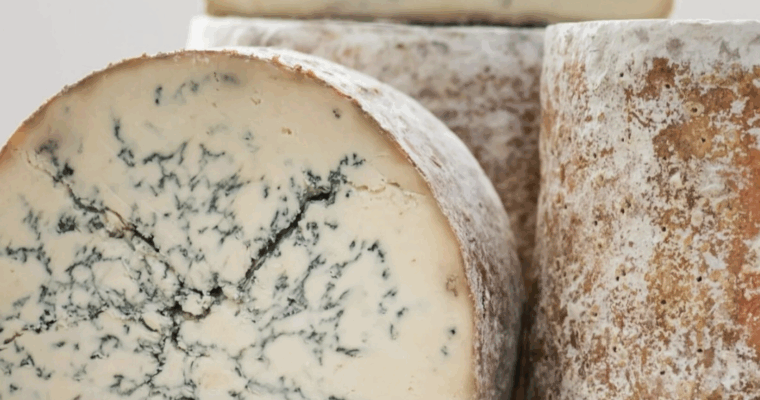
It’s our first post in a while that’s actually about cheese. It’s November and I’ve just finished teaching class on Stilton and Port, the perfect duo for these cold nights. They’re a classic pairing, and I thought I’d write about them together. What I realized, …
Our previous post was about the Trethowan Brother’s Gorwydd Caerphilly, so we decided it made sense for our next post to be about Pitchfork Cheddar, a West Country Farmhouse PDO Cheddar, also made by the Trethowans! When the brothers left Wales, where they had already …
I’ve always been drawn to Caerphilly. It’s a Southern Welsh cheese, and family lore says my great-grandparents on my mother’s side were Welsh coal miners before they emigrated to Pennsylvania. Beyond that though, I think Gorwydd Caerphilly maybe the prettiest cheese I’ve ever seen.
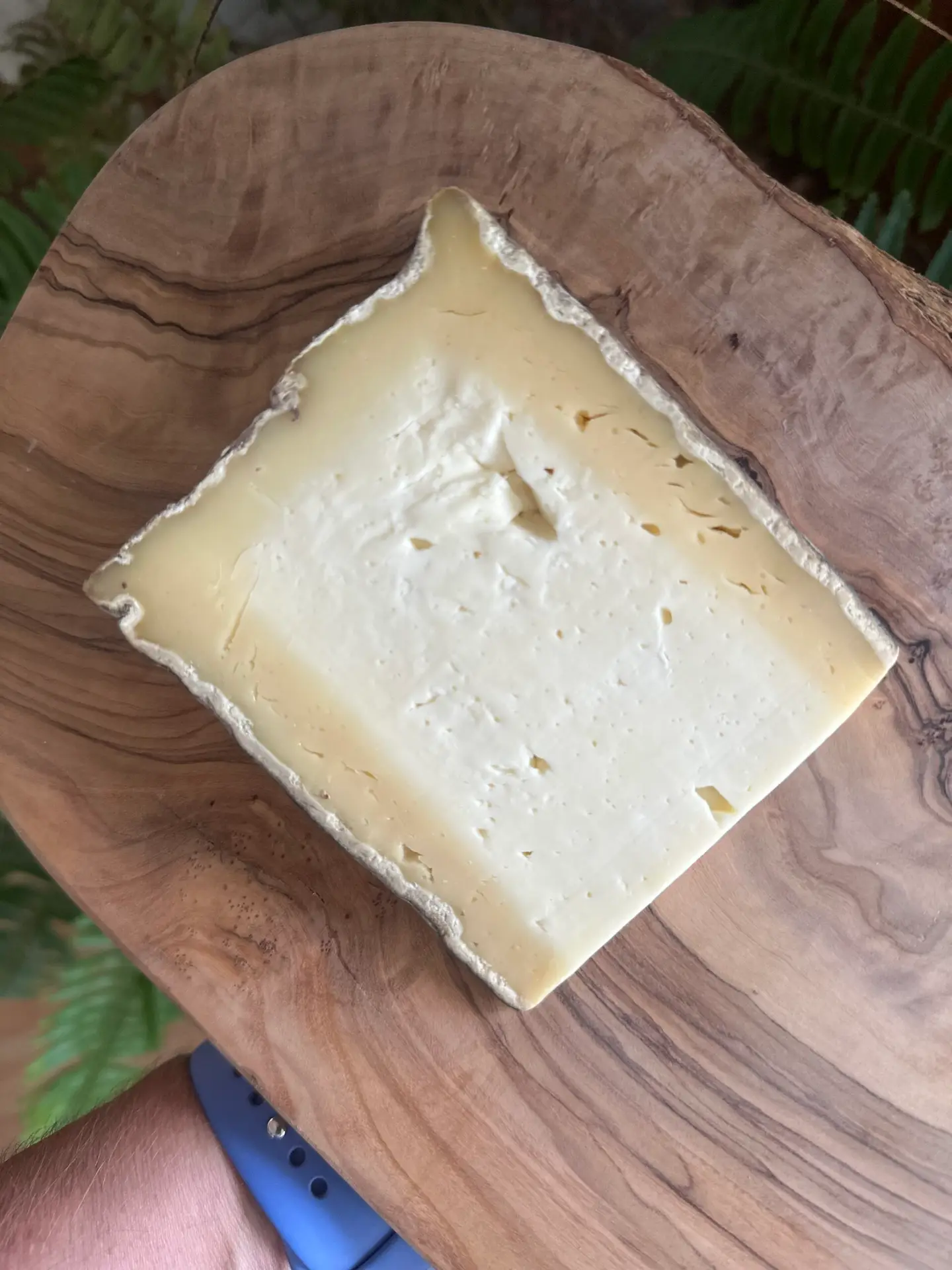
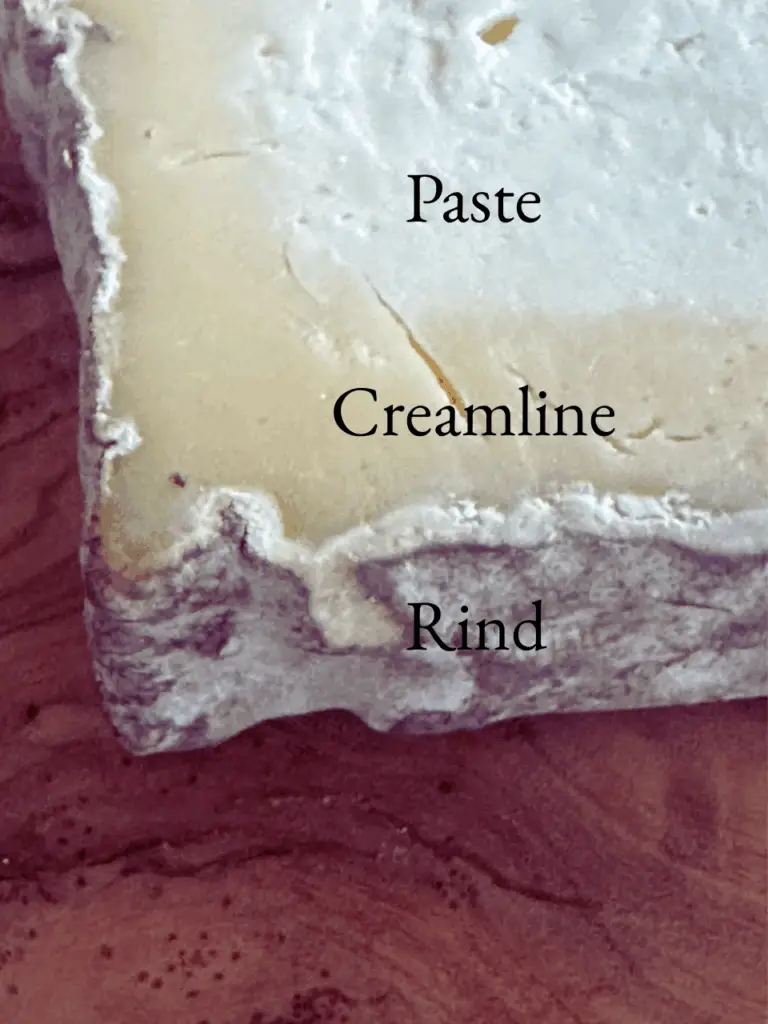
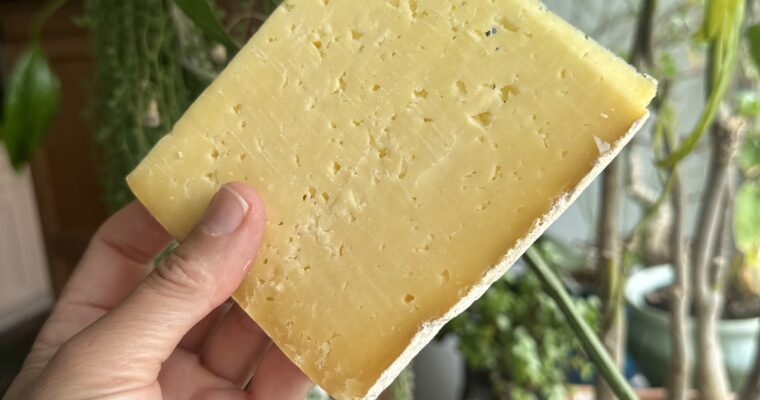
What makes Gorwydd Caerphilly so distinctive though is how easily you can see it ripen in layers. The rind develops a coat of natural molds that smell of wet stone and earth. Just beneath the rind is the creamline, where the process called proteolysis loosens proteins and fats, making it smooth and silky. It gives buttery, vegetal, and mushroomy notes.
At the center, the paste stays bright, crumbly, and clean, with high calcium lending it a chalky texture and lemony snap. Each part tastes different because microbes and enzymes work their way inward. The outside transforms and the middle stays fresh. Tasting Gorwydd Caerphilly is like eating three cheeses in one: mineral, mushroom, and milk all in balance. Here’s your cheese lesson for the day, that you can apply to any cheese. Rind, Creamline, and Paste, all on display.
Caerphilly layers
Cheese of Miners
Caerphilly was first made on farms and sold in local markets, often to miners who needed something sustaining and salty to take underground. Young wheels were wrapped in cabbage leaves to keep the rinds from drying and cracking, a practical solution that left the cheese faintly vegetal. As we discussed with Wensleydale, the curd retains moisture, so has a quicker aging process than what you’d find with a cheddar. The cheese arrived at market a lot sooner, which was later appealing to industrial cheesemakers.
Aritz: A wedge of Caerphilly and bread could be eaten one-handed in the dark of the pit, and its salt helped replace what they lost in sweat. This was food for survival, not luxury.
Eglantine: Oh, Aritz, you say that about every cheese! I’m never sure whether you’re trying to guilt us out of the pleasure of the cheese.
I wonder sometimes if my great-grandparents ate Caerphilly.
Modern History of Caerphilly
By the late 20th century, farmhouse Caerphilly had nearly vanished. Sound familiar? Bland factory blocks replaced gorgeous farmstead cheese, over and over again. Todd Trethowan discovered this loss first-hand while working part-time at Neal’s Yard Dairy in London. Todd later apprenticed under Chris Duckett, who at the time was the last farmhouse Caerphilly maker in Britain. Determined to keep the tradition alive, Todd began making Gorwydd Caerphilly in 1996 on his family’s farm in Ceredigion, West Wales. His brother Maugan soon joined him, and together they built the Trethowan Brothers.
Gorwydd Caerphilly Today
As demand grew, the family farm could no longer keep up. In 2014 the brothers relocated production to Puxton Court Farm in Somerset, just five miles from Cheddar. There they built a dairy and secured milk from a single, well-managed herd. The move gave them consistency, more space, and the chance to control every step of production and maturation. They also rescued a heritage starter culture that had nearly disappeared, ensuring Gorwydd retained a distinct microbial identity. Under this new roof, they continued Gorwydd Caerphilly and launched a second raw-milk cheese, Pitchfork Cheddar, my favorite Somerset Cheddar and subject of a future post!
Eglantine: Do not forget the cows, please. The Trethowans chose Somerset because they could draw from a single herd, cows grazing deep grass and clover. Close your eyes and try to taste the clover. You can taste it in the brightness of the curd and the gentle sweetness behind the lemon snap. Healthy pastures, healthy milk, delicious cheese.
Pairings
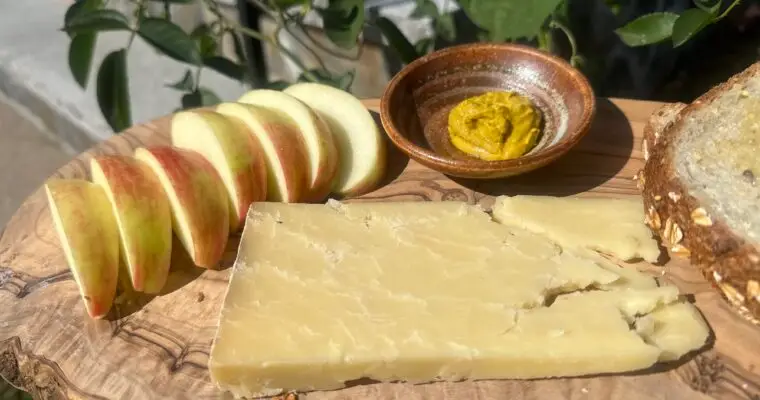
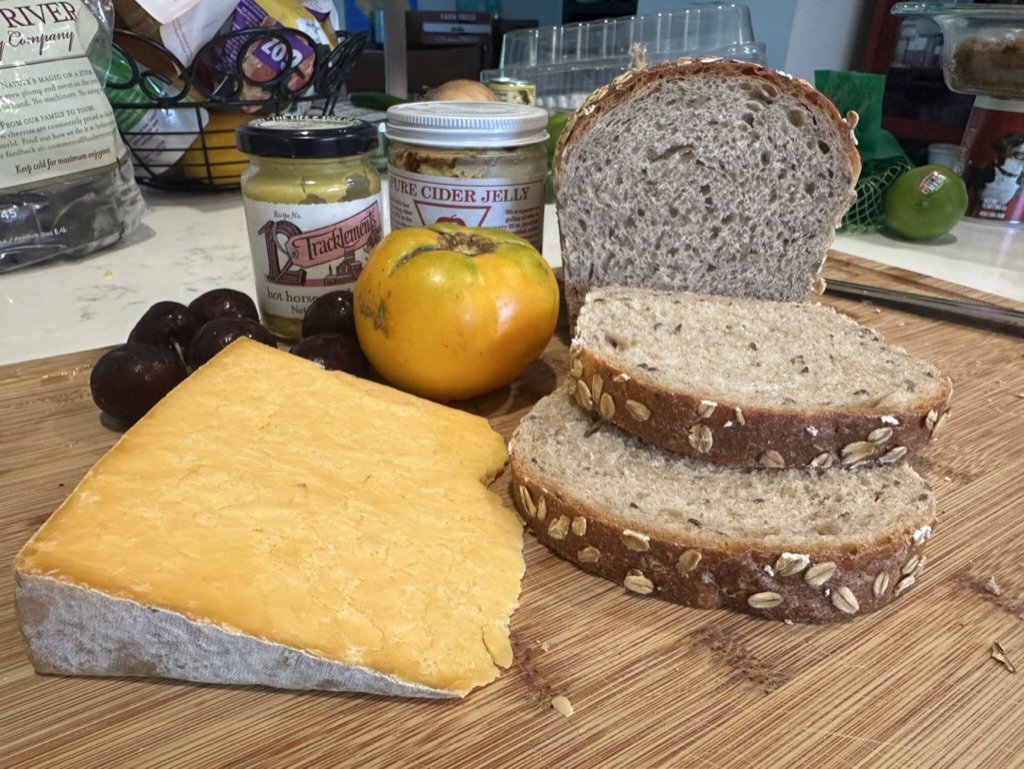
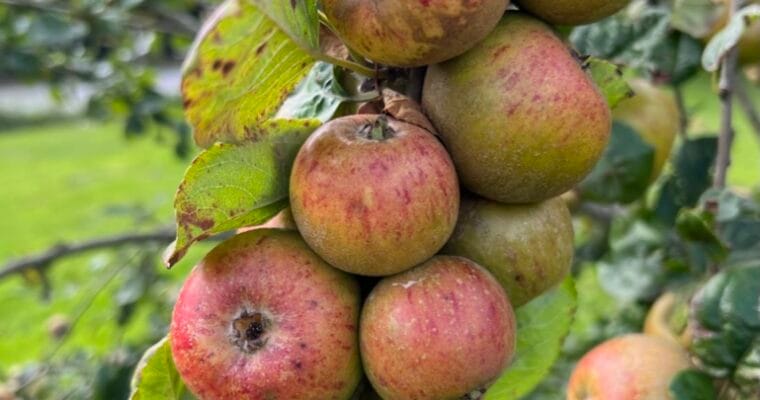
Gorwydd Caerphilly shines with cider, the classic Welsh and English companion. If you’d read any of our other posts, you know we’re big fans of dry cider. For this cheese in particular, the lively acidity and gentle tannin cut the richness and echo the apple-sharp notes in the core. Bitter ales also bring out its earthy side. On the table, pair it with pickles, mustard, or a hunk of dark bread. For a more delicate match, fresh green apples or pears highlight its clean minerality.
Yoredale from Curlew Dairy in the Yorkshire Dales, is real farmhouse Wensleydale, brought back from extinction. For many people, Wensleydale means the industrial blocks in the supermarket, studded with cranberries at Christmas. Yoredale shows what the cheese was meant to be. It’s one of my …
Kirkham’s Lancashire is an English Territorial, one of the Crumblies, and one of my favorites. It’s buttery, tangy, and as one of my colleagues said, “fluffy.” However, when people see Kirkham’s Lancashire on the counter, they figure it’s another cheddar. With this post, we’re hoping …
It’s our first cheese post! Here we go! Appleby’s Cheshire comes from Hawkstone Abbey Farm in Shropshire, England. The Appleby family founded the farm in 1952, and now Paul Appleby and his wife Sarah carry on the work, with help from their five children. They craft their farmstead cheese from raw milk, traditional cultures and rennet, and salt from the Cheshire Plains, and aged about 3 months. It’s grassy, complex, and subtle, perfectly paired with a good cider or fresh fruit.
Eglantine Crumb: Farmstead means the cheesemakers use milk from animals living right there on the farm. That ensures freshness, and that the cheesemakers know exactly what’s happening with the pastures and the cows. The Appleby family’s herd is mostly Friesian-cross, and they’ve been working with them to improve soil health, which benefits us all. Aritz and I will have more to say soon about how animals and microbes can help undo the harm caused by industrial farming.
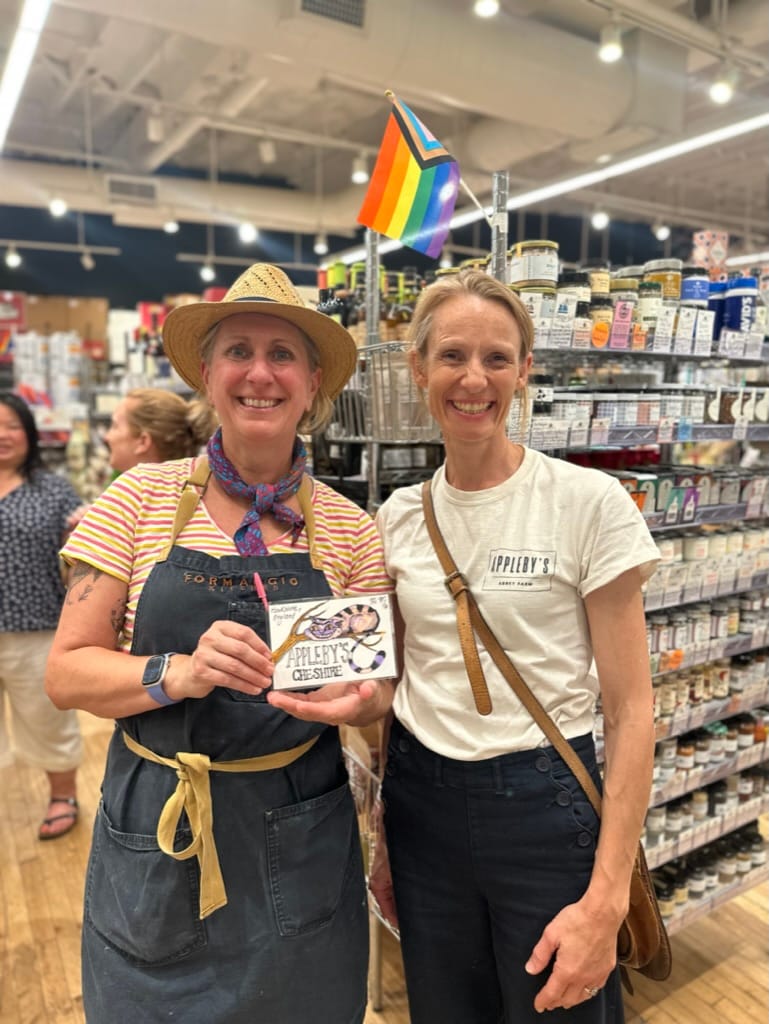
Sarah Appleby and Jennifer Tolliver at Formaggio Kitchen
What is Cheshire
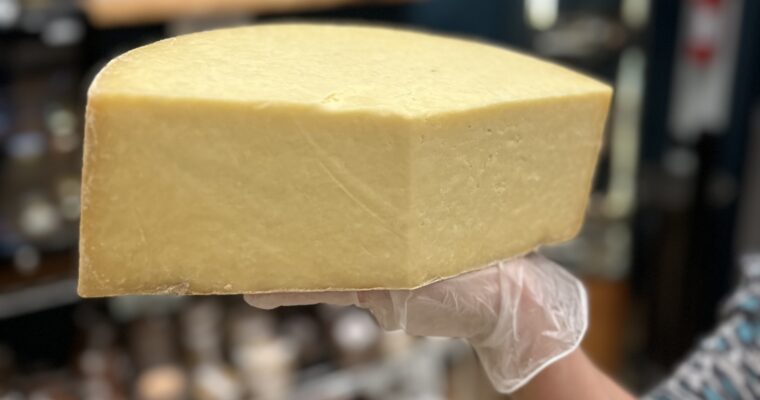
Cheshire is a hard cow’s milk cheese made not only in Cheshire itself, but also in Shropshire, Staffordshire, Warwickshire, and northeastern Wales. It may be the oldest of the British Territorials. You can find cheese from Cheshire mentioned in the Domesday Book of 1086, when villagers paid rent in wheels of it. We can’t be sure it was the same style we know today, but it’s delightful to imagine.
“British Territorials” refers to regional cheeses officially described in the late nineteenth and early twentieth centuries. Cheeses in Britain (and much of Europe) have place names. The Cheshire Plain is known for its lush pasture, as well as its salt and sandstone that give Cheshire its distinctive minerality.
By the 17th and 18th centuries, Cheshire was the most popular cheese in Britain. The Royal Navy purchased only Cheshire to feed their crew for many decades, and Cheshire was the first cheese shipped to London markets on a large scale. Unlike cheesemakers who skimmed cream for butter, Cheshire required whole milk, and the full cream made it tastier. No wonder everyone loves Cheshire!
Aritz Rind: Don’t blame the cheese for empire building! It didn’t ask to be dragged around the world in the service of conquest!
Cheshire Milk & Culture
Cheshire makers traditionally use a mix of morning and evening milk. Morning milk is lower in fat, evening milk higher, so the balance is perfect for cheese. (I’m already looking forward to our post about milking times!) To the warmed milk, Appleby’s adds a traditional starter from Barbers, who have made Cheddar since 1833.
Aritz Rind: Appleby’s does indeed use Barber’s culture, but they push the microbes harder, encouraging a faster acidification than cheddar requires. The rapid pH drop means the milk loses calcium, leaving a weaker curd and more crumbliness.
There were marketing reasons to add color (see our earlier post.) Southern English markets preferred their Cheshire dyed with annatto, while Northerners like it plain. Appleby’s makes both, but Neal’s Yard Dairy exports the orange version to the U.S.
Eglantine Crumb: Southerners and their fussing! Forever wanting their Cheshire red and tidy, as though a dash of dye makes a difference. We Northerners know better. We care about flavor, not frippery.
Aritz Rind: On that point, Eglantine, we agree.
I think the orange looks striking on a cheese board.
Cutting the Curd
Eglantine Crumb: Once the curd sets, it’s cut into smaller pieces than cheddar’s. Like many British cheeses, Cheshire is crumbly, which requires expelling plenty of whey. But unlike cheddar, the curds are handled gently.
Aritz Rind: Cheshire retains moisture, which allows it to ripen more quickly. Microbes thrive in moisture, so the extra water lets them get to work faster.
Eglantine Crumb: The cheesemakers salt the curd before hooping (moulding.) In cloth-lined moulds, they press the curds in vintage presses, beautiful old things, that squeeze out the last bit of whey.
The cheesemakers turn out the wheels and age them for about 3 months. At Appleby’s, they mature in barns with timbers dating back to the Napoleonic era, which lend their own flora to the cheese. (It’s also pretty freaking cool.)
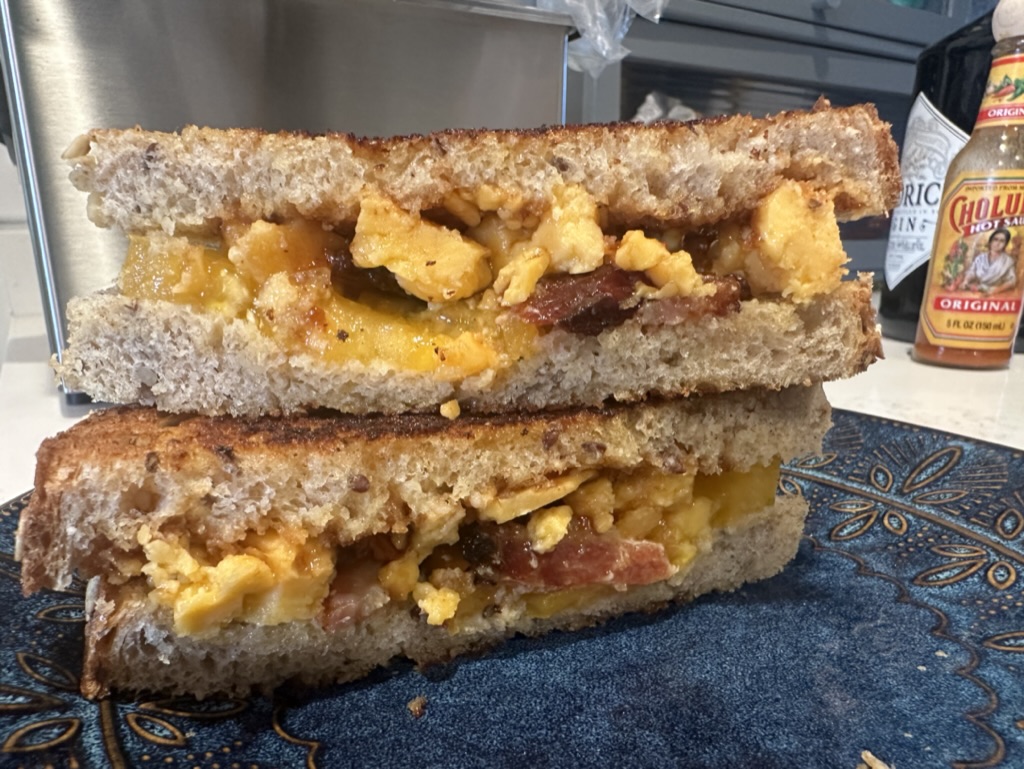
Cheshire and Bacon Sandwich
Go Eat It!
A wheel of Cheshire reflects many influences: the pasture, the milk, the culture, and even the timbers above its head. Appleby’s is a gorgeous, artisanal cheese, and the last-standing, traditional farmstead Cheshire. It is well worth the effort to seek it out. If you need help finding it, please contact us!
We’ll shortly be posting a simple recipe from Jen and Eglantine! Stay tuned!
I’m teaching a British Cheese and Cider class this weekend, so I thought I’d share a little about why I’m so excited about it. While I’m currently the British Cheese Buyer at Formaggio Kitchen, I used to work at a natural cidery, Botanist & Barrel. …
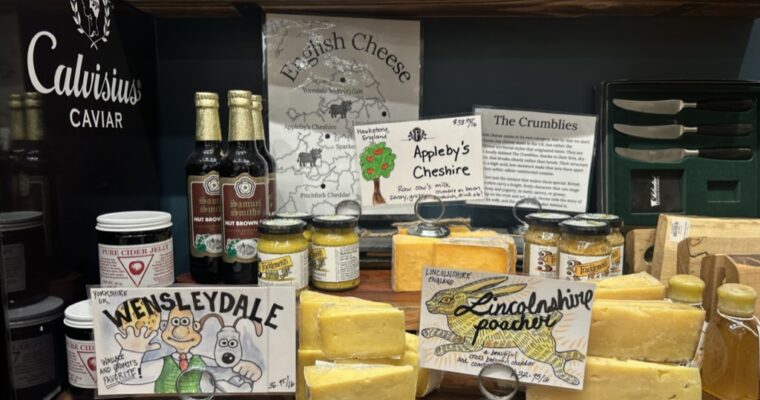
British cheese exists in its own category. And by that we don’t just mean any cheese made in the UK, but rather the traditional territorial styles that originated there. They are often fondly dubbed The Crumblies, (specifically Cheshire, Caerphilly, Wensleydale, and Lancashire,) thanks to their …