Wrapped in stinging nettles before it matures, Cornish Yarg is one of the most recognizable cheeses in Britain. The nettles encourage a delicate bloomy rind while the interior stays creamy, fresh, and lightly tangy. It’s the kind of cheese I always associate with summer: perfect …
For many years, Consider Bardwell Farm made Pawlet and Rupert from Woodlawn Farm’s cow milk. Consider Bardwell closed shortly after Covid due to some bad luck, but the Leach family at Woodlawn decided to keep the cheese going, so they brought the cheesemaking to their …
In the 1970s, a quiet revolution began in the counterculture kitchens of West Cork, Ireland. It was led by Veronica Steele, the pioneer who created Milleens and gave rise to the Irish farmhouse cheese industry. Soon after, two other names became synonymous with this artisanal awakening: Gubbeen and Durrus.
These three families proved that the Irish “terroir” could produce world-class washed-rind cheeses. The Steeles of Milleens legacy, Jeffa Gill of Durrus, and the Fergusons of Gubbeen remain the pillars of Irish Farmhouse Cheese.
The Windswept Terroir
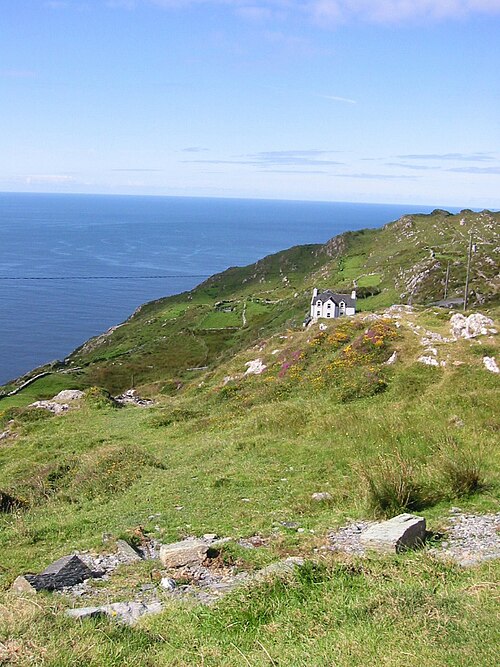
West Cork is the southwesternmost part of Ireland. It is ruggedly gorgeous and remote. Centuries of deforestation and thin, rocky soils have left the land exposed, yet it remains emerald green year-round thanks to the temperate Atlantic climate. Heavy farming machinery would destroy the little topsoil left, so this is best left for the dairy cow!
Eglantine: These Irish lasses graze on hardy grasses and wildflowers, producing milk with depth. Lucky country for cows, that’s for certain.
Aritz: Hippies always end up where the land is cheap and the grass is good.
Crucially, the salty, cold Atlantic air provides the perfect natural humidity for aging. In the maturation rooms, this maritime atmosphere encourages the Brevibacterium linens to thrive, giving Durrus its pinkish-orange rind.
Here We Go On Again About Monks
Long before the 1970s cheese revival, Ireland’s spiritual exports laid the groundwork for European cheesemaking. During the “Golden Age” of the 6th and 7th centuries, Irish monks traveled across Europe, establishing monasteries from Iona to the Alps. These Peregrinati (wandering monks) brought with them advanced agricultural knowledge, including cheese making and aging. In many of the great European abbeys, it was these religious communities that perfected the art of “washing” cheese rinds with brine or booze to keep them moist and ward off unwanted molds.
When Veronica Steele, Giana Ferguson, and Jeffa Gill began washing their rinds in West Cork, they weren’t borrowing a French technique. They were bringing a tradition home, completing a 1,500-year-old circle that started in the stone cells of Irish abbeys.
Eglantine: I grew up among the ruins of an abbey in Yorkshire and made Wensleydale for most of my life, but I didn’t fully understand what those monks had given us until I began traveling. I’ll tell these stories soon enough.
A Modern Renaissance
Today, Durrus exists in an Ireland that is rapidly redefining itself. After centuries of colonization and political strife, the healing nation has emerged as a high-tech powerhouse and the Silicon Valley of the EU. This influx of global wealth and a new, well-traveled generation in Ireland has sparked a culinary rediscovery. The Irish are no longer just exporters of raw ingredients; they are curators of their own food systems. I got to see this first hand while I was learning at Ballymaloe Cookery School in County Cork.
Aritz: Colonization always breaks the food first. Seeing the Irish make their own cheese again is a fine thing. That’s resistance, whether they call it that or not.
The Profile: Durrus Farmhouse
Durrus was created by Jeffa Gill in the Coomkeen Valley on the Sheep’s Head Peninsula of County Cork, Ireland. It is a pasteurized, semi-soft washed rind cheese that captures the essence of the Cork countryside. They also make a raw milk version which I encourage you to find if you’re on that side of the Atlantic.
Durrus is creamy, milky and mild when young, and develops a savory character when aged.
Texture: Pliable and smooth with a thin, slightly tacky rind.
Aroma: Earthy, damp hay
Taste: Buttery to nutty.
Pairings: A dry craft cider, a medium-bodied White Burgundy, honeycomb, or tart apple chutney.
I ran the final miles with my heart hammering against my ribs, but the relief kept me moving. My fur was dull and matted with the dust of the road. My body was so much stronger than when I left, but I was weary. Yesterday, …
Now that we’re back from our winter break, it’s time to start the year with the heavyweights. It is still snowing as I write this, and there is no better “snow day” cheese than a cooked-curd Alpine. The two neighbors, Swiss Le Gruyère AOP from …
Vacherin Mont d’Or is the ultimate holiday season cheese, and that has less to do with marketing than with timing. It is made in the colder months, when alpine herds have come down from high pastures and milk is no longer destined for long-aged wheels like Comté or Gruyère. Instead, that richer winter milk is turned into something meant to be eaten quickly, while winter is still holding on.
This is part of what makes Vacherin Mont d’Or special. It is not a cheese built for storage or long travel. It is meant to be eaten young, soft, and a little wild. Because it is high in moisture, lightly washed, and aged for only a short period of time, it does not last long. It appears just as people are gathering and cooking more, looking for foods that feel rich and comforting. It behaves less like a commodity cheese and more like a seasonal dish.
What is Vacherin?
It might be my lawyer and linguist background, but I like to know what words actually mean. Vacherin is a confusing one. I asked one of our cheese experts at Formaggio Kitchen for clarification. He explained that the word vacherin comes from vache, meaning cow. Despite how simple that sounds, it is not a generic style name.
Vacherin is historically and culturally tied to specific regions of Switzerland and eastern France, especially the Jura. Outside of that context, the word is not used broadly. You would not find a random tomme labeled “vacherin,” even though both are cow’s milk cheeses. When we use the word today, we are usually referring to Vacherin Mont d’Or, or to cheeses made deliberately in its tradition.
To complicate things further, we often use the word alpine loosely, to mean cheeses made at altitude rather than cheeses made in the Alps themselves. I spent a lot of time hiking in California’s Sierra Nevada, where “alpine” refers to climate and elevation above the treeline. Even in the Alps, the word alp historically refers to pastureland rather than mountains.
I am still learning to understand the distinctions between the Alps and the nearby Jura, and seeing those differences clearly has helped me better understand the cheeses that come from each place. We shared a separate post from Eglantine exploring the Jura in more depth, which helped clarify that geography for me.
Other Vacherins?
Vacherin Mont d’Or itself exists in both Swiss and French forms. On the French side of the Jura, the cheese is Vacherin du Haut-Doubs. While regulations differ slightly between the two AOPs, the cheeses share the same essential character: a soft, washed rind cow’s milk cheese produced in winter and supported by a band of spruce bark. For most eaters, the differences are subtle, and the two are best understood as regional expressions of the same tradition.
It is also worth noting that Vacherin Mont d’Or is not the same cheese as Vacherin Fribourgeois à la sangle. (Sangle simply means strap or band in French.) Vacherin Fribourgeois is a firm, aged alpine cheese, more closely related to Gruyère and commonly used in fondue, though it too is traditionally bound with spruce. The overlap in names reflects regional history rather than similarity in style.
If any of this feels confusing, that is because it is. Cheese traditions and naming conventions are messy, just like the rest of human history. If you take one thing from this section, I hope it is that you feel more comfortable asking questions and talking things through with your local cheesemonger.
They Call Me Spruce
OK, let’s talk about something a lot less confusing. Spruce Bark. The wood and bark from the spruce tree were historically used for everything from construction to storage. In cheesemaking, the band of spruce helps hold the soft cheese together as it ripens, it allows the paste to remain supple rather than collapsing, and it gives the cheese a subtle, resinous aroma that feels especially at home in winter.
Spruce isn’t the only conifer that grows in alpine regions, so why didn’t they choose pine or fir? Spruce bark is flexible, strong, and relatively mild in aroma, which makes it well suited to wrapping a very soft cheese. Pine and fir tend to have sharper, more resinous compounds and bark that is either too brittle or too aggressive in flavor. Over time, spruce proved to be the most reliable material for supporting the cheese without overwhelming it, and tradition followed function.
That spruce scent is one of the reasons Vacherin Mont d’Or feels so tied to the season. Spruce smells like cold air, evergreen branches, and snow underfoot. Even when you are eating it indoors, at a table far from the Jura, the cheese carries a sense of place with it. Many domestic versions also use spruce, because it is such an integral part of the experience.
Washing the cheese
The washing is more gentle and controlled than some other washed rind cheese we know. You can read more about washed rinds here. A quick review though, is that the rind is typically washed with a light brine, sometimes including native cellar cultures. The goal is not to soak the cheese, but to encourage the development of a soft, aromatic rind and keep unwanted molds in check. With Vacherin Mont d’Or, the paste is so soft and high in moisture, excessive washing would damage the structure, so the washing is restrained.
In cheeses like Taleggio or Époisses, washing is a primary driver of ripening. Their regular and more assertive washing encourages the development of a thick, sticky rind and strong surface flora. Those cheeses are firm enough to hold their shape without external support. The washing continues for much of the aging process and is central to how those cheeses develop their texture and flavor. Vacherin Mont d’Or is softer, but has the band of spruce to help it keep shape.
Over time, the interaction between the washed rind, the spruce, and the cellar all give the cheese its characteristic aroma. The result is a washed rind cheese that is aromatic but not as assertive. Vacherin Mont d’Or tends to be softer, milder, and more custard-like at the center, with the spruce contributing as much to the overall aroma and taste as the washing itself.
Enjoying Vacherin Mont d’Or
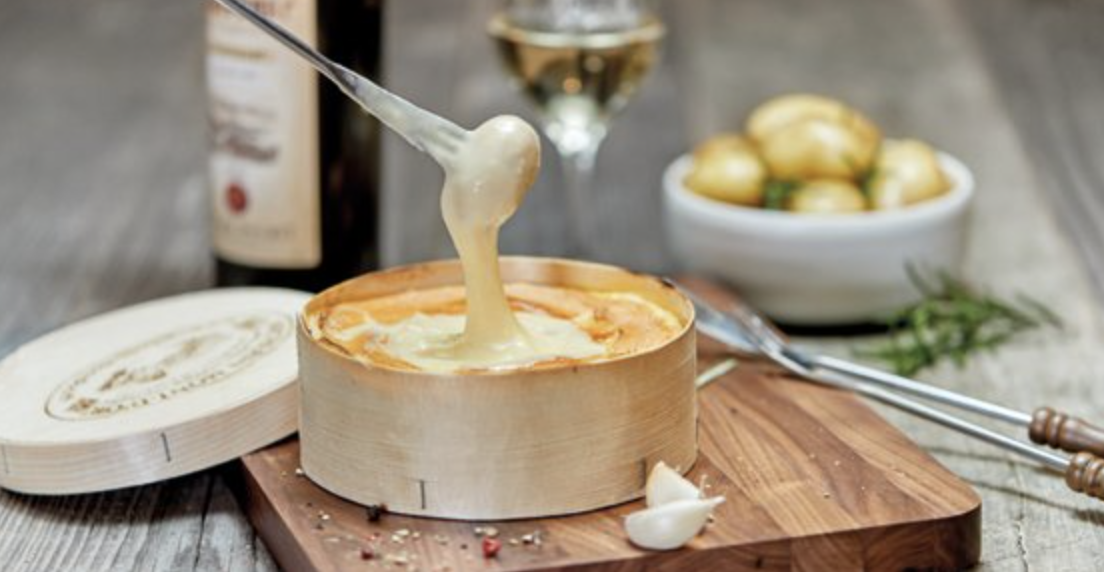
Vacherin Mont d’Or is a cheese that invites ritual. You can spoon it, or warm it gently in the oven, or set it out with bread and potatoes and let everyone help themselves. We recommend baking it in its spruce band, with a bit of rosemary and garlic stuck right in. Pair it with a nutty, dry Jura white wine, and we guarantee a carefree, luxurious winter evening.
If you want another look at its history, production, and place in the Jura, another colleague and expert at Formaggio Kitchen, Adam Centamore, wrote an excellent piece for Cheese Professor.
Eglantine Crumb’s Field Notes Full Moon, Snow Settled Vallée de Joux, Jura Near the French-Swiss Border I’ve been in the Jura for a time. How much time? I don’t know. But I have a curious feeling of being very aware of time, and not especially …
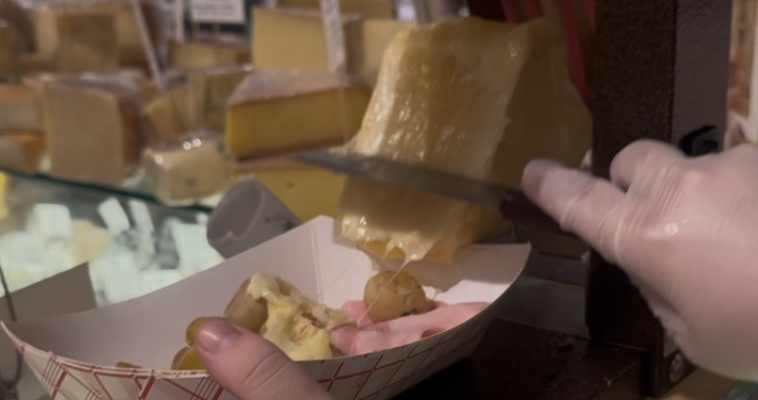
We’re serving raclette at the South End Formaggio Kitchen this winter season where I work as a Cheesemonger. Happily, I’m also teaching a class on raclette (and fondue) at the Formaggio Kitchen in Cambridge. We’re keeping it seasonal around here! What is Raclette? Raclette can …
Eglantine Crumb’s Field Notes Waxing Rind Moon, Snow Deepening Chalet above Martigny, near La Fouly Canton of Valais, Switzerland
On my last evening with Aritz in Aosta, we had what he called a simple meal, though it felt quite grand to me. We were on the banks of the Dora Baltea, a tributary of the Po River. The cold snowmelt of the river was bracing and wild, so I was glad to have a hot meal. Our first course was fonduta alla valdostana, an Italian fondue made with Fontina and not a drop of wine. Before they make the Fonduta in Aosta, they soak Fontina in milk, sometimes overnight. So melty and creamy! I must write down the recipe before I forget!
On my way out of the Valley of Aosta, I walked under the Arch of Augustus. The words of Stendhal came to mind along the way:
I was so happy in contemplating these beautiful landscapes and the triumphal arch of Aosta that I had but one wish to make: that this life would last forever.
The reality that this journey home might last indefinitely is a little worrying, but I am enjoying the food and adventures so much, a part of me does wish it wouldn’t end.
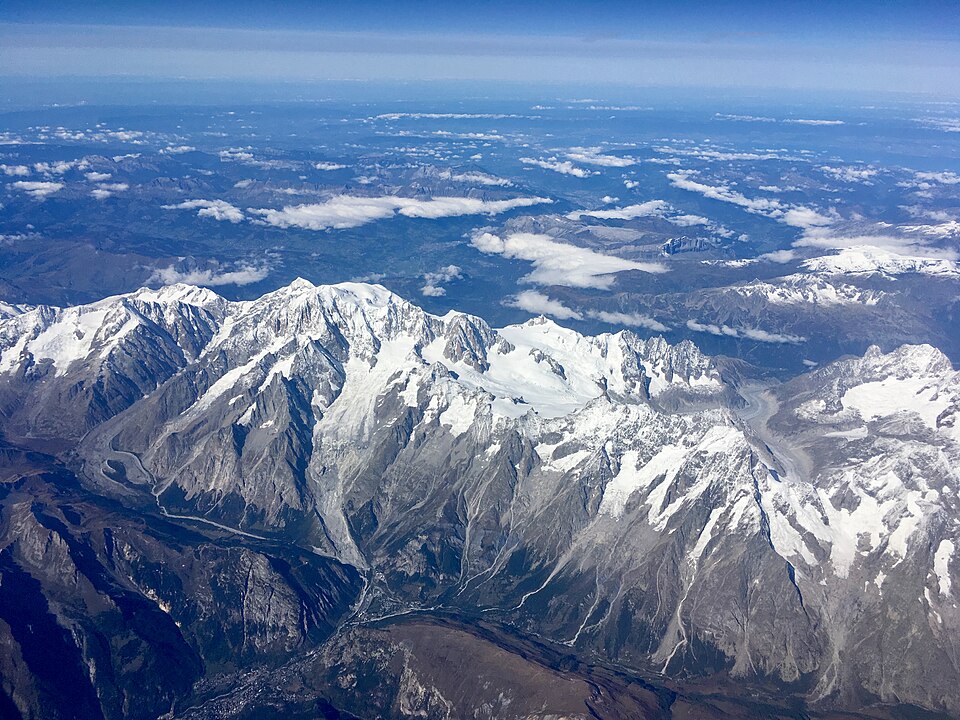
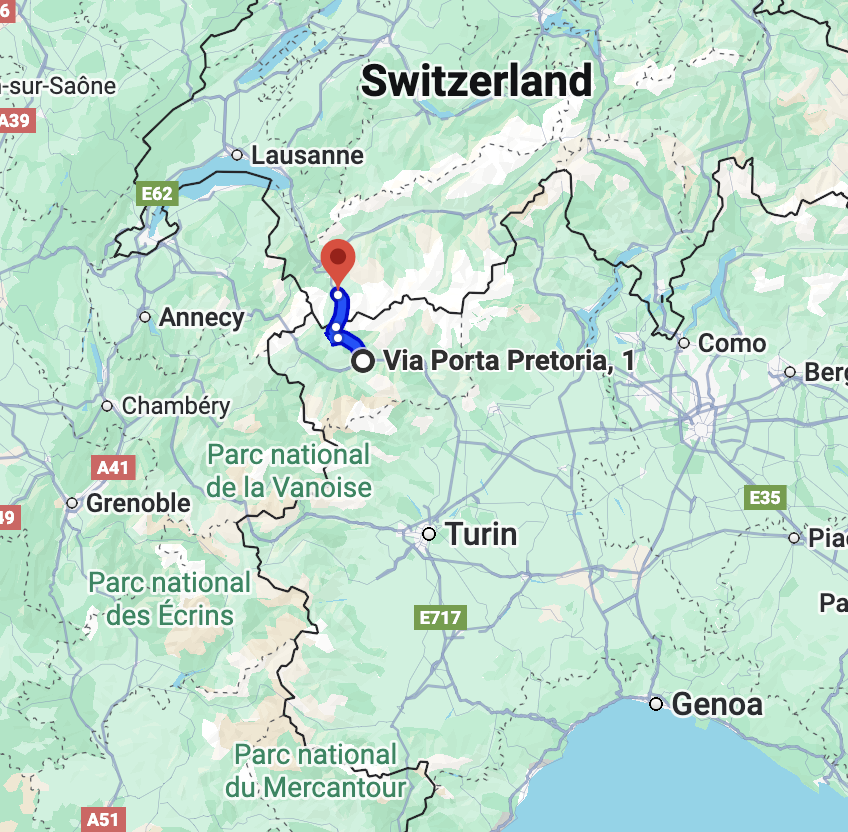
Mont Blanc, or Monte Bianco depending on who you ask, was in the distance as I headed for the Great St. Bernard Pass. It seems I am walking the Via Francigena, from Puglia back to England. After my adventures through Italy, I do feel more of a cheese crusader than a holy one! The pilgrimage is best done in the summer, and I quickly realized my mistake. I was heading north through the Pennine Alps in the winter! It was a bit cold, of course, but we’re made from tougher stuff in Yorkshire. I knew I could manage. But the snow was another matter. My feet kept sinking in it.
And this is one of my prouder moments, I must say. Outside the Great St. Bernard Hospice at the top of the pass, I found some spruce bark and attached it to my feet with the bit of Fontina I’d tucked in my pocket. If that’s not ingenuity, I don’t know what is. Instant snowshoes!
I trudged along, following hand-painted signs toward Martigny in the Canton of Valais, Switzerland. The moon lit the way, the nights sometimes brighter than the afternoons of long mountain shadows. I sensed someone following me, but it felt like a kind soul, so I trusted my instincts and forged ahead, whistling a tune to keep my spirits up.
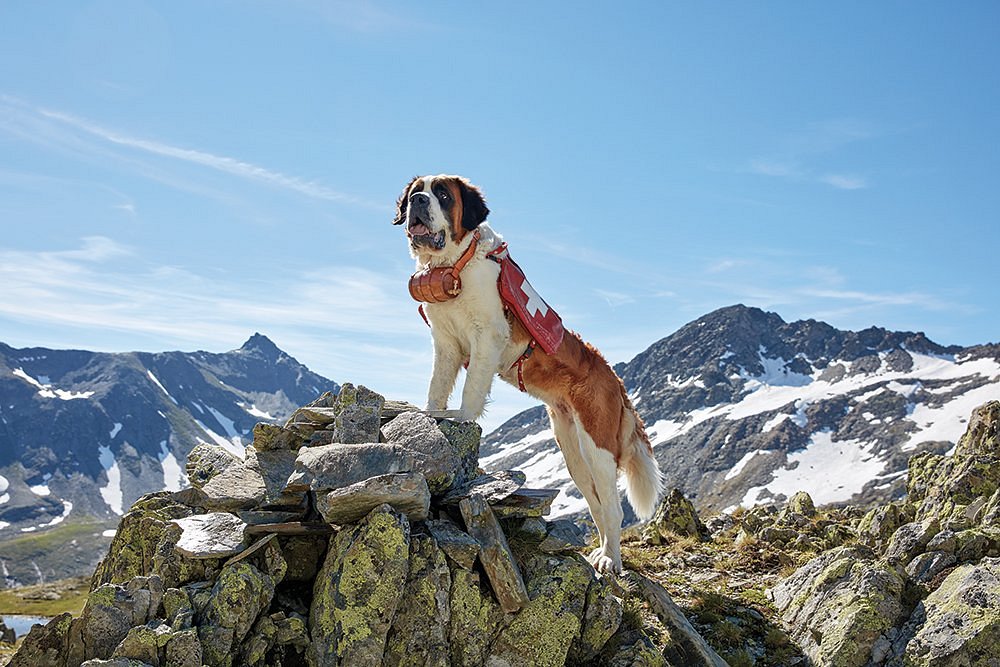
Finally, the snow came down so heavily I had to surrender. Just as I was pondering shelter, a guide from the monastery emerged from the woods. The St. Bernard told me he’d followed me as a favor to a friend, and had found me easily because of the smell of Fontina on my feet. I had an idea who this “friend” was, Aritz being entirely capable of communicating over distances thanks to his mycelium network.
The Dog said not to mind the howling wind, that it was simply the Wild Hunt passing through, and he would keep me safe until I found shelter. He was very kind, and said it was his mission in life to help travelers through the treacherous pass. I asked if he had a brandy barrel under his chin, but he was quite serious about his job and pretended not to hear me.
He guided me to a quiet chalet, still aglow from a party earlier in the evening. The Dog said the chalet’s resident Cat was friendly enough, and I was a lot safer with her than I was outside with the Owls! The Cat lived on fondue and raclette, and had no need to hunt. In fact, she was on good terms with the Mice under the floorboards! The Dog pushed the door open for me and followed me in.
Imagine my surprise to find Aritz already there, a glass of Fendant in hand, completely in his cups.
Me: “Aritz Rind! You Basque rascal! How on earth did you get here before me?” Aritz: “Barbegazi! (hic) I could hear you whistling in the wind. (hic) Have you come to warn us of an avalanche?”
I didn’t know who Barbegazi was, but I did see the icicles hanging from my chin like a beard, and the spruce bark Fontina’d to my feet. I told him it was me, Eglantine Crumb, on my way home to England. He laughed and said I was an Alpine snow goblin! He’d been at the mushrooms again, I was sure.
He wasn’t alone. Three Swiss Mice were making merry with him: Marcel, Gaspard, and Colette. Typical of the Swiss, they immediately commented on the smell from my feet. Marcel said Fontina from Aosta was not as good as Raclette from Valais. Colette said foot glue was the best use for it. Typical European cheese chauvinists! No different than the Italians. They all think their region is the best. And to think we were only 50 kilometres from where Aritz and I had our last Italian meal!
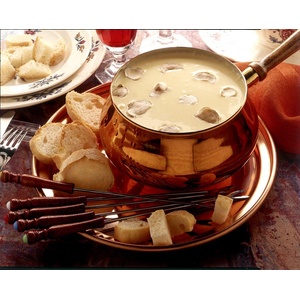
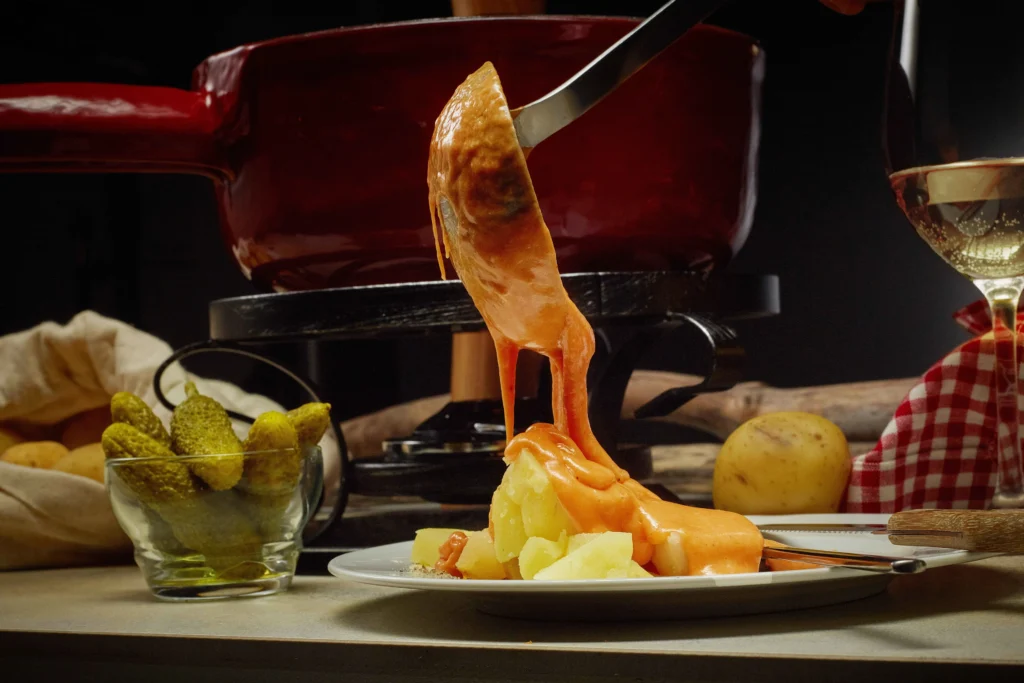
I looked around and saw a few caquelons half filled with unfamiliar sort of fondue. It was almost pink! Fondue valaisanne à la tomate, made with their local Raclette and tomato. They like to pour the fondue instead of dip. There were bits of apple, cornichon, pickled onions, viande séchée du Valais (local air-dried beef,) and pain de seigle (rye bread) They said Fondue was a special occasion food, that they more often ate the Raclette scraped right off the wheel. It was a cheerful sight after the long, hungry trek through the snow! And I had to admit, I was ready for a change from Fontina, lovely though it is. Anything would lose its sparkle after it’s been stuck to your feet for days on end.
I settled in with a cup of black tea and enjoyed a bit of fondue. The Swiss mice approved; they said the tannins in the tea helped break up the richness, and might be easier on my tummy than wine. I didn’t want any wine until I’d spotted the Cat, I needed to keep my wits about me. Still on alert, I warmed my feet by the fire and let the Fontina melt right off.
Aritz eventually recognized me. Took him long enough!
Aritz: “Hannibal Crumb! Come over the Alps with your elephant?” Gaspard: “No, Monsieur Rind, she came over with the Dog.” Marcel: “Rind is so small, he thinks the Dog is an elephant.” Colette: “It does not matter. Hannibal did not come through the Great St. Bernard Pass. He crossed via the Clapier Pass. Polybius wrote it.” Marcel: “Polybius was a dramatist. Livy said Montgenèvre.”
At that moment, the Cat emerged, huge and very sleepy. She told the Mice to be quiet, and that Aritz had been making a joke. She looked at me and nodded to let me know I was safe. So I was ready for the glass of Fendant, a beloved white wine from Valais. It was crisp, with a bit of fruitiness and minerality that worked so well with the cheese sauce. The Cat who was lapping up a bit of Fendant as well, said it was made from the Chasselas grape, and was possibly named for the grape’s tendency to split, or fendre.
The Cat welcomed me and said Valais was no stranger to travelers, perched as it is on the crossroads of the Alps. She asked about my travels. I told her I’d started far to the south and simply kept heading north. I made it clear I wanted to get home, but I was having such a good time finding new cheeses and recipes, that I didn’t mind a detour here and there.
Aritz went on again about Elephants and how I, being a Mouse, would have frightened them all. He’s a dear friend, but at times far too pleased with himself. I asked the Cat where she thought I should go next, and she suggested a little further west, to check out Gruyère. Aritz promised he’d make sure I met friendly sorts along the way.
My head is sinking into my pillow. I reckon I’ll stay a bit in Valais. The snow has closed the pass, and the Mice want me to try Raclette de Valais scraped from the wheel, and Aritz knows of a local cheesemaker we can investigate together. I’m in for a cozy night now, I’ll report back soon!
Eglantine Crumb, is a Yorkshire Cheesemaker who happens to be a Mouse. Not long ago, she found herself trapped in a shipping container was transported far from home. This is one of her journal entries.
Believe it or not, I’m calling this a seasonal post! A lot of our winter cheeses have washed rinds. Vacherin Mont d’Or, Epoisses, even Gruyère and Comté. Many of the cheeses we melt in the colder months, like Raclette, are on the stronger, funkier side, …