Cheddaring
Often I hear, “Oh, I just like boring cheese like cheddar” or if I suggest a cheddar to try, they look disappointed. But it’s a fantastic cheese! Cheddar is the cheese most of us know by name, but very few of us truly know. When we say “cheddar,” we might mean anything from a clothbound wheel aged in a stone cellar to a shrink-wrapped orange slice from the supermarket. At its core, though, cheddar is not a flavor, it is a method for making cheese! (In another post, we’ll talk about capital “C” Cheddar from the West Country of England, but for now we’re just talking about lower case “c” cheddar. It’ll make sense soon, I promise!
Starting at the Beginning
Cheese begins as milk, warmed and inoculated with cultures. For cheddar, mesophilic cultures are used, and they like it warm, but not hot. These microbes feast on lactose, producing lactic acid, and begin the transformation from milk into curds and whey. It’s the same as when lemon lands in milky tea: acid makes the proteins pull together.
Eglantine: Aye, this is where it all begins. Some makers use a packet of cultures, others save a ladle of whey from yesterday’s batch, like a sourdough starter. And if the milk’s raw, it’s already carrying a good share of its own microbes from the farm. That’s why each cheddar tastes a bit different, even when the recipe’s the same. You can’t pull the curd away from the land it comes from.
Rennet comes next, helping the casein proteins bond into a springy mass. After resting, the curd is cut into small pieces to let the whey escape. The finer the cut, the drier and firmer the final cheese. Cheddar curds are stirred and gently heated, removing even more moisture. The less water and lactose left behind, the safer the cheese will be to age. Microbes love damp, sugary environments, and cheddar’s healthy future depends on denying bad microbes a place to grow.
Aritz: This is control. By chasing out moisture, they shut the door on spoilage and give power to the microbes they want.
Cheddaring
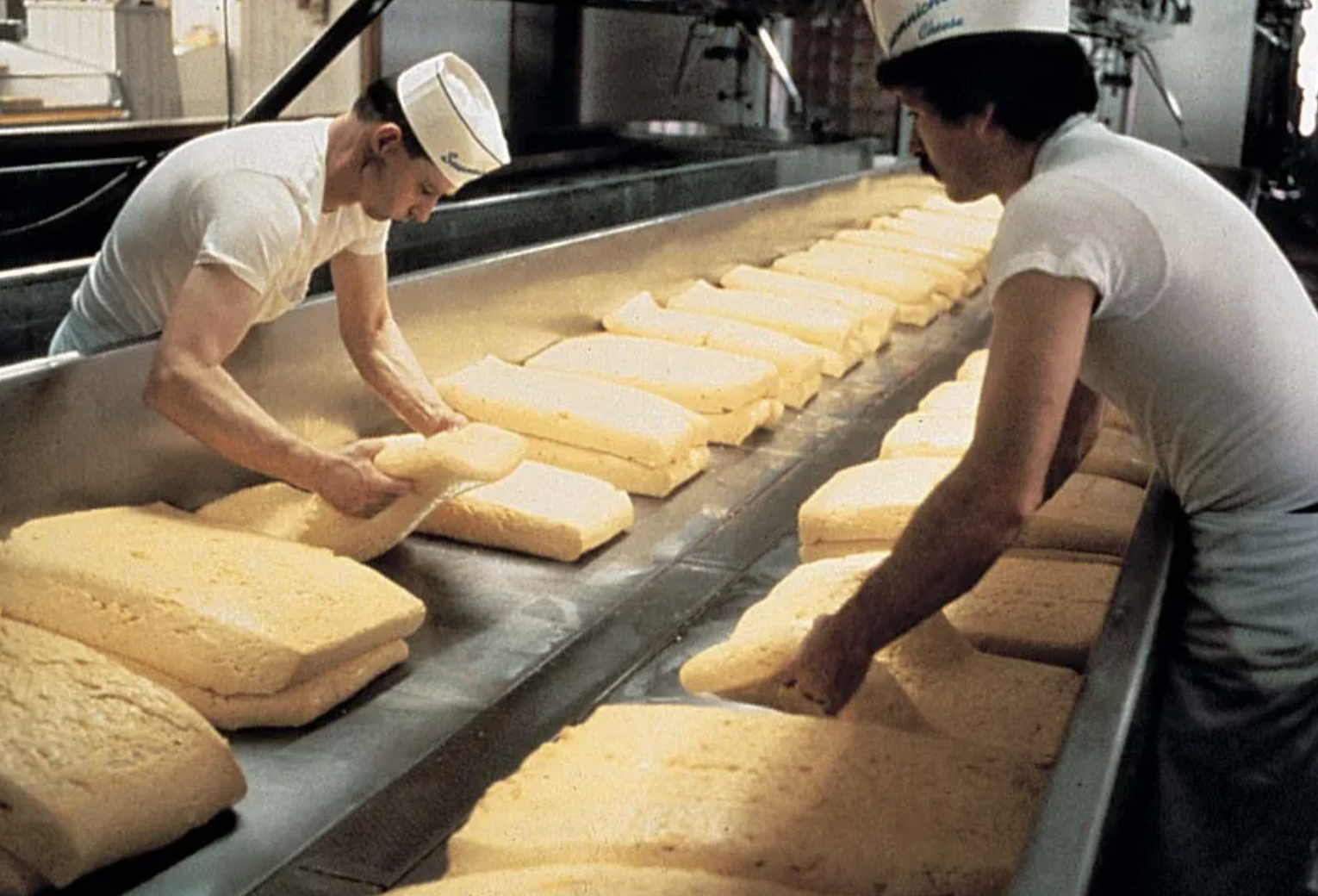
And then comes cheddaring! The curds are cut into slabs, stacked, cut apart, and stacked again. Over and over, the cheesemaker lifts, flips, and presses the warm curd. Each repetition drives out more whey and reshapes the proteins, giving the curd its distinctive layered texture. It’s heavy, physical work, more like kneading bread or stretching mozzarella than anything else in cheesemaking. When the curd is ready, it is milled into small pieces and salted by hand.
Eglantine: When you’re stacking and turning those slabs, you can feel the curd firming under your hands. It’s hard work, but that’s where cheddar gets its backbone. By the time it’s milled and salted, it’s ready to stand up to pressing and months in the cave.
Aritz: Don’t forget the labor. Microbes do the heavy lifting, but for the humans, cheddaring is back-breaking work. Industrial block cheddar is cheap because machines do the lifting and stacking. In farmhouse dairies, it’s still people’s bodies doing it. If you value the cheese, you value their work.
The Finish
Salted curds are then pressed into hoops, where they knit into solid wheels under heavy weight. Once out of their molds, the cheeses are ready for aging. Cheddar can be aged months, sometimes years.
What we’re used to, even in the US and UK (the cheddar nations) are the block cheddars. Instead of being aged in caves, with natural or clothbound rinds, they are vacuum sealed. They retain a bit more moisture and do not develop the earthy flavors of a cheddar that has aged in a cave. Some of them are quite good, and there are artisanal choices. If you are able, I encourage you to try the less industrial versions.
Cheddaring transforms a simple curd into something sturdy, complex, and built to last. It is a style of making that spread from Somerset across the world, but always tied to the unique act of stacking slabs of curd, again and again, until the milk becomes something greater.