Vacherin Mont d’Or
The Cheese for the Coldest Months
Vacherin Mont d’Or is the ultimate holiday season cheese, and that has less to do with marketing than with timing. It is made in the colder months, when alpine herds have come down from high pastures and milk is no longer destined for long-aged wheels like Comté or Gruyère. Instead, that richer winter milk is turned into something meant to be eaten quickly, while winter is still holding on.
This is part of what makes Vacherin Mont d’Or special. It is not a cheese built for storage or long travel. It is meant to be eaten young, soft, and a little wild. Because it is high in moisture, lightly washed, and aged for only a short period of time, it does not last long. It appears just as people are gathering and cooking more, looking for foods that feel rich and comforting. It behaves less like a commodity cheese and more like a seasonal dish.
What is Vacherin?
It might be my lawyer and linguist background, but I like to know what words actually mean. Vacherin is a confusing one. I asked one of our cheese experts at Formaggio Kitchen for clarification. He explained that the word vacherin comes from vache, meaning cow. Despite how simple that sounds, it is not a generic style name.
Vacherin is historically and culturally tied to specific regions of Switzerland and eastern France, especially the Jura. Outside of that context, the word is not used broadly. You would not find a random tomme labeled “vacherin,” even though both are cow’s milk cheeses. When we use the word today, we are usually referring to Vacherin Mont d’Or, or to cheeses made deliberately in its tradition.
To complicate things further, we often use the word alpine loosely, to mean cheeses made at altitude rather than cheeses made in the Alps themselves. I spent a lot of time hiking in California’s Sierra Nevada, where “alpine” refers to climate and elevation above the treeline. Even in the Alps, the word alp historically refers to pastureland rather than mountains.
I am still learning to understand the distinctions between the Alps and the nearby Jura, and seeing those differences clearly has helped me better understand the cheeses that come from each place. We shared a separate post from Eglantine exploring the Jura in more depth, which helped clarify that geography for me.
Other Vacherins?
Vacherin Mont d’Or itself exists in both Swiss and French forms. On the French side of the Jura, the cheese is Vacherin du Haut-Doubs. While regulations differ slightly between the two AOPs, the cheeses share the same essential character: a soft, washed rind cow’s milk cheese produced in winter and supported by a band of spruce bark. For most eaters, the differences are subtle, and the two are best understood as regional expressions of the same tradition.
It is also worth noting that Vacherin Mont d’Or is not the same cheese as Vacherin Fribourgeois à la sangle. (Sangle simply means strap or band in French.) Vacherin Fribourgeois is a firm, aged alpine cheese, more closely related to Gruyère and commonly used in fondue, though it too is traditionally bound with spruce. The overlap in names reflects regional history rather than similarity in style.
If any of this feels confusing, that is because it is. Cheese traditions and naming conventions are messy, just like the rest of human history. If you take one thing from this section, I hope it is that you feel more comfortable asking questions and talking things through with your local cheesemonger.
They Call Me Spruce
OK, let’s talk about something a lot less confusing. Spruce Bark. The wood and bark from the spruce tree were historically used for everything from construction to storage. In cheesemaking, the band of spruce helps hold the soft cheese together as it ripens, it allows the paste to remain supple rather than collapsing, and it gives the cheese a subtle, resinous aroma that feels especially at home in winter.
Spruce isn’t the only conifer that grows in alpine regions, so why didn’t they choose pine or fir? Spruce bark is flexible, strong, and relatively mild in aroma, which makes it well suited to wrapping a very soft cheese. Pine and fir tend to have sharper, more resinous compounds and bark that is either too brittle or too aggressive in flavor. Over time, spruce proved to be the most reliable material for supporting the cheese without overwhelming it, and tradition followed function.
That spruce scent is one of the reasons Vacherin Mont d’Or feels so tied to the season. Spruce smells like cold air, evergreen branches, and snow underfoot. Even when you are eating it indoors, at a table far from the Jura, the cheese carries a sense of place with it. Many domestic versions also use spruce, because it is such an integral part of the experience.
Washing the cheese
The washing is more gentle and controlled than some other washed rind cheese we know. You can read more about washed rinds here. A quick review though, is that the rind is typically washed with a light brine, sometimes including native cellar cultures. The goal is not to soak the cheese, but to encourage the development of a soft, aromatic rind and keep unwanted molds in check. With Vacherin Mont d’Or, the paste is so soft and high in moisture, excessive washing would damage the structure, so the washing is restrained.
In cheeses like Taleggio or Époisses, washing is a primary driver of ripening. Their regular and more assertive washing encourages the development of a thick, sticky rind and strong surface flora. Those cheeses are firm enough to hold their shape without external support. The washing continues for much of the aging process and is central to how those cheeses develop their texture and flavor. Vacherin Mont d’Or is softer, but has the band of spruce to help it keep shape.
Over time, the interaction between the washed rind, the spruce, and the cellar all give the cheese its characteristic aroma. The result is a washed rind cheese that is aromatic but not as assertive. Vacherin Mont d’Or tends to be softer, milder, and more custard-like at the center, with the spruce contributing as much to the overall aroma and taste as the washing itself.
Enjoying Vacherin Mont d’Or
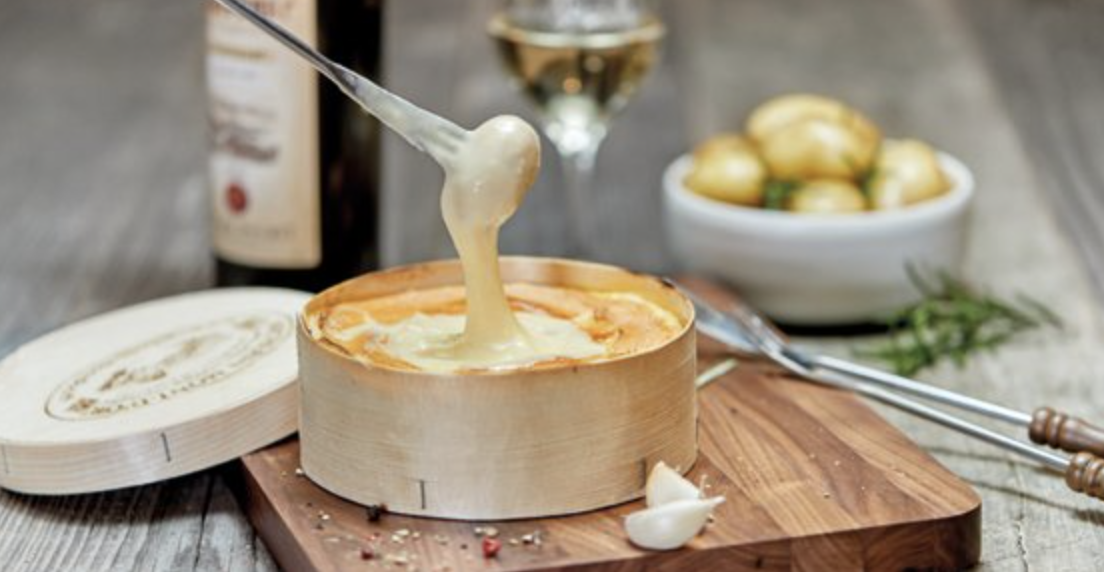
Vacherin Mont d’Or is a cheese that invites ritual. You can spoon it, or warm it gently in the oven, or set it out with bread and potatoes and let everyone help themselves. We recommend baking it in its spruce band, with a bit of rosemary and garlic stuck right in. Pair it with a nutty, dry Jura white wine, and we guarantee a carefree, luxurious winter evening.
If you want another look at its history, production, and place in the Jura, another colleague and expert at Formaggio Kitchen, Adam Centamore, wrote an excellent piece for Cheese Professor.